
A Capsule Wardrobe With Actual Personality
Direct answer
Direct answer: build a capsule wardrobe with personality by choosing repeatable outfit roles first, then filling each role with pieces that carry your preferred color, shape, print or texture. A capsule should reduce decision fatigue, not turn your closet beige.
The phrase "capsule wardrobe" has a reputation problem. Too often it sounds like a polite little exile for every piece with a pulse. Ten neutral items, all agreeable, all optimized for not offending the mirror. That may work for someone whose dream outfit is quiet tailoring. It does not work for a person who uses clothes as voltage.
A useful capsule is not an aesthetic prison. It is a working system. It helps you repeat combinations, spend more deliberately and get dressed without rebuilding your identity every morning. The personality is not a bonus; it is the reason the system will actually be worn.
Start with outfit roles, not item counts
Most capsule advice starts with a number. Twelve pieces. Thirty pieces. A seasonal edit. Numbers can help, but they can also distract from the real question: what jobs does your wardrobe need to perform?
Make a list of roles before you list garments. You might need a work polish formula, a casual errand formula, a dinner formula, a travel formula, a hot-day formula and a "I need to look alive in seven minutes" formula. A capsule works when each role has a reliable outfit path.
Vogue's recent capsule guidance is useful here because it treats the capsule as personal foundations rather than a universal list. The pieces that earn space are the ones you reach for often, that fit well and that support the life you actually live.
Pick anchors that make bold pieces easier
A personality capsule needs anchors. Anchors are not boring; they are stabilizers. They let the strong piece look intentional instead of stranded. For Royal Bitch Couture, an anchor might be a black trouser, a clean skirt, a fitted jacket, a repeatable boot or one of the simpler pieces from Tees & Tops.
The anchor's job is to repeat. If a dramatic top works with three bottoms and two layers, it belongs. If a printed skirt only works with one imaginary blouse you never wear, it may be a costume piece rather than a capsule piece.
Choose anchors in shapes you already trust. A capsule fails when it is built around the person you think you should become. It succeeds when it makes your real preferences easier to combine.
Keep the statement pieces, but give them rules
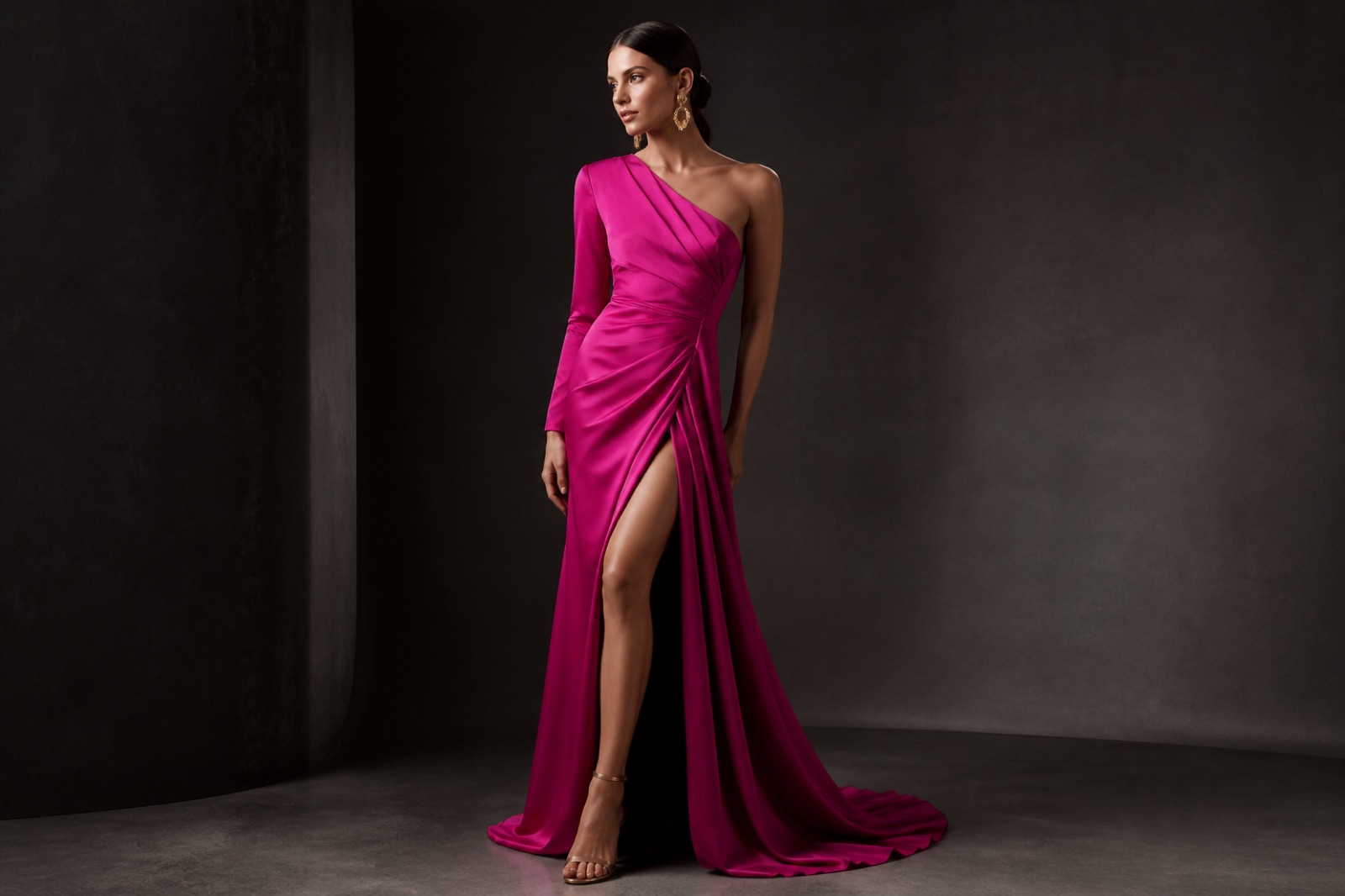
Statement pieces do not ruin a capsule. Unassigned statement pieces do. A bold dress from Signature Dresses can be a capsule hero if you know its lanes: with boots and a jacket for dinner, with a cleaner shoe for an event, with a plain layer for daytime. The question is not whether the piece is loud. The question is whether it can repeat without feeling like a one-night performance.
Use one lead piece per outfit. Color can lead. Shape can lead. Print can lead. Texture can lead. Letting one element lead gives the outfit a point of view. Letting every element compete makes the wardrobe harder to use, even if every item is individually gorgeous.
This is where many minimalist capsules go wrong for bold dressers. They mistake personality for chaos. The better move is editing: keep the piece with attitude, then build a small grammar around it.
Edit without erasing yourself
Before removing anything, sort by evidence. What did you wear in the last month? What do you reach for when time is short? What gets compliments that feel like you, not like surprise? What pieces make other pieces easier?
Then sort the rest into three groups: wrong fit, wrong life and waiting for a role. Wrong fit is usually a repair, tailoring or goodbye decision. Wrong life belongs to a previous version of your routine. Waiting for a role may stay if you can name three outfits for it by the end of the week.
A capsule should not flatten mood. Keep one impractical joy piece if it genuinely gives you joy. Keep color if color is your baseline. Keep edge if edge is what makes simple outfits feel alive. The edit is there to remove noise, not to punish taste.
Shop slowly and verify the gap
The fastest way to ruin a capsule is to shop for the fantasy list before testing the actual closet. Wear your draft capsule for two weeks. Write down what was missing. Maybe you need a layer, not five tops. Maybe the issue is shoes. Maybe your "work" outfit fails because every bag fights the jacket.
When you do buy, buy for a named role. "Black structured layer for graphic tees." "Comfortable shoe that makes the dress daytime." "Top that works under the loud jacket." That kind of shopping keeps personality intact because the purchase has a job.
Royal Bitch Couture also keeps purpose language honest. This article does not invent donation totals, rescue partnerships or impact claims. If a wardrobe is tied to values, the values need evidence just like the outfit needs structure. You can read the current brand purpose page at Helping P.E.T.S. without turning this capsule guide into a claim it cannot support.
The final test is simple. Can you make ten outfits that feel like you, fit your real week and repeat without boredom? If yes, the capsule is working. If the outfits are efficient but lifeless, put personality back in. A smaller wardrobe should give your style a sharper voice, not a smaller one.
One practical exercise is the three-look test. Take one lead piece and make it work for three real settings: weekday, weekend and evening. Do not change your whole identity for each setting. Change the anchor, shoe, layer or jewelry. If the piece cannot survive that test, it may still be worth keeping, but it should not be counted as a core capsule item.
Color can be handled the same way. You do not need a rainbow to have personality, and you do not need neutrals to have discipline. Choose two base colors, one contrast color and one print or texture that repeats. That small pattern gives the closet coherence without forcing every outfit into the same mood.
Fit is the unglamorous part that makes the whole thing work. A capsule depends on repetition, and repetition punishes pieces that pinch, twist, slide or require constant adjustment. Tailoring, better underlayers and honest sizing often do more for personal style than another dramatic purchase.
FAQ
Does a capsule wardrobe have to be neutral?
No. Neutral pieces can help, but the capsule should reflect the colors, shapes and textures you actually wear.
How many statement pieces belong in a capsule?
Use enough to make outfits feel like you, but give each statement piece repeatable anchors and at least three outfit paths.
Should I buy a full capsule at once?
No. Test your closet first, then shop only for gaps with named roles.
Sources consulted: British Vogue capsule wardrobe guide, Vogue 2026 wardrobe essentials, Who What Wear 2026 capsule wardrobe, Real Simple closet decluttering questions. Featured image: existing site asset, /assets/img/photo-hero.jpg.